Standard Garage Door Torsion Springs
Introduction to Torsion Springs Video



To buy standard garage door torsion springs go directly to our torsion spring prices at the bottom of this page.
We currently stock 1 3/4," 2," 2 1/4," and 2 5/8" ID torsion springs and cones for residential doors. For all other types of springs go to our Garage Door Springs page. For an engineer's perspective on torsion springs we recommend you visit Richard Kinch's page titled "How I Replaced Deadly Garage Door Torsion Springs And lived to tell the tale." He has a lot of helpful information and engineering formulas there.
To assure you are ordering the correct springs, read or review this page. The extra time should prove beneficial. Over the years we have discovered that informed customers are happier.
Standard residential torsion springs are found on a shaft above the center of the garage door. These springs typically come in 1 3/4", 2" and 2 1/4" inside diameters. If you have a broken torsion spring, read below to make the measurements you need, and then purchase a new garage door spring or springs.
Included below are a number of popular torsion spring topics, many of which you may want to consider before ordering a new standard torsion spring for your garage door.
Learn About Standard Residential Torsion Spring Systems
Popular Torsion Spring Topics
Buy Residential Garage Door Springs
- » Measuring Your Garage Door
- » Special Orders
- » Purchase Standard Torsion Springs with our Find My Spring Database™
Other Important Links
Introduction to Standard Torsion Springs
A standard torsion spring has a stationary cone which secures the spring to the spring anchor bracket. Since this bracket is secured to the wall, the stationary cone, as its name suggests, does not move. The other end of the torsion spring has a winding cone. This winding cone is used when installing, adjusting, and uninstalling the springs. When installing the torsion spring, the coils of the spring are wound up to create a lot of torque.
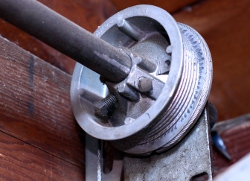
The torque transfers from the shaft to the cable drum, pulling the cable and the bottom of the garage door upward.
Since these cables hold the weight of the garage door, the torque from the torsion springs does not dangerously spin the shaft until the spring is loose. Instead, the garage door weight slightly exceeds the lift produced by the torsion spring(s). (The lift is the amount of weight that each spring can raise off the ground.) As a result, a properly operating garage door with the right springs should not seem to weigh nearly as much as the garage door itself. When this principle holds true through the duration of the door's travel, the door is balanced.
With the help of the torsion springs, you should be able to operate the garage door manually without much trouble. Likewise, it does not take too much work from the garage door opener to lift the garage door. As the door opens (either manually or with the opener), the torque on the shaft keeps the cable tight on the cable drum. As a result, the cable winds up on the cable drum, allowing the torsion springs to unwind.
As the torsion spring unwinds, it loses some of its torque. Therefore, it also loses the amount of lift that it can produce. Vertical lift and high lift garage doors deal with this problem in a slightly different way, and you can read about How Vertical-Lift and High-Lift Garage Doors Work. Standard lift garage doors are almost universally used in residential garages and are in the majority in commercial and industrial settings.
It all comes down to the cable drums. Standard lift cable drums have a flat portion for the cable, with one or two grooves that are a little higher. (These higher grooves are addressed in the link above.) As the garage door opens, the rollers slide along the track. The door transitions from the vertical track to the horizontal track.
When the horizontal track supports the top section, each spring does not need to support as much weight. Since the springs have unwound a little by this point, the amount of weight supported by the horizontal tracks roughly equals the lift that was lost from the decrease in torque in the torsion springs.
When the garage door is fully open, there is still about 3/4 to 1 turn still applied to each torsion spring. Since the bottom roller on the garage door typically rests on the curved portion of the track, the door will want to fall down. The extra torque in the torsion springs, though minimal in comparison to the torque when the garage door is closed, keeps the door open.
Popular Torsion Spring Topics
Included below are a number of popular topics that interest homeowners when considering torsion spring purchases. Though it may be helpful to consider these options, they do not apply to all garage doors.
Replace Both Torsion Springs?
If you have two torsion springs on your door, you should replace both of them. Most doors have springs with the same cycle life rating. In other words, when one spring breaks, the other spring will probably break before too much longer. Since you will be going to the trouble of changing one torsion spring, it is usually better to change your second spring as well. This will save you time in the garage as well as money on the shipping costs.
Some doors, however, have two springs with different dimensions. Many times, the cycle life of the broken spring is shorter than the cycle life of the unbroken spring. This means that you may still have another couple thousand cycles left on your unbroken spring. If you only change one spring now, you will probably need to change your other spring fairly soon down the road. Therefore, we recommend that you still replace both springs, but that you purchase springs with the same length, inside diameter and wire size.
If this is the case, each of your new torsion springs will need to lift 1/2 of the total lift of your two old springs. A matched pair of springs can be determined for you by using our Unmatched Springs calculator.
For help determining whether you should replace both springs on your door, see our Torsion Spring FAQ's page. You can also read more about springs with different dimensions.
One Spring or Two?
A lot of people have a garage door with only spring on it and wonder whether they should upgrade to two springs. If the new torsion spring that you will install on your door has an inside diameter (ID) of 1-3/4" and a wire size of .250 or larger, we suggest that you convert to two torsion springs. The same holds true with a 2" ID and .2625 wire size or a 2-1/4" ID and .283 wire size.
The problem with having a larger wire size on a single-spring door is that the spring pulls on the shaft as the door opens and closes. This can cause serious problems in the future, including cables breaking or peeling off the drums and steel sections getting damaged. While it usually costs $5-$10 to convert over to two springs, it can save a lot of money down the road.
One question that people frequently ask when converting to two springs is whether they need a second bearing for the second spring. The answer is no. The purpose of the bearing is to keep the stationary cone centered on the shaft so that the spring is centered on the shaft. Since the stationary cones from the two springs will be secured to each other in the process of securing the springs to the spring anchor bracket, the second spring does not need a bearing. Additionally, adding a second bearing will probably break one or both of the stationary cones.
For more information to help you decide whether to have one spring on your garage door or two, see our One Torsion Spring or Two? page.
Different Spring Dimensions?
If your two spring dimensions are not the same, we recommend switching to a pair of springs with the same dimensions. While it is possible to use unmatched springs, you are more likely to get the maximum cycle life out of a pair of springs when they are the same length, wire size and inside diameter.
If you purchased two torsion springs with different dimensions, it is possible to maximize the cycle life on the two springs. See our Maximizing Cycle Life on Unmatched Torsion Springs page for more information.
If you currently have unmatched springs and wish to convert to a pair of matched springs, or if you want to read how to use unmatched pairs, see our Using Torsion Springs with Different Lifts page.
Longer Life Torsion Spring Options
The cycle life of a torsion spring refers the to rating regarding how many cycles (the door opening and closing is one cycle) the spring should make before it breaks. The cycle life rating does not account for premature breakage, often caused by chips in the steel or highly corrosive environments.
The standard cycle life in the garage door industry is 10,000 cycles. Spring under 10,000 cycles are considered overstressed and are not recommended for use. If you would like to have more than 10,000 spring cycles, your new torsion springs will need to have a larger wire size. The larger the wire, the longer it will take for the spring to break as thicker steel requires more bending before it breaks.
If you increase the wire size of your springs, you will also need to increase the length to keep the same lift and torque rating. On narrower, heavier doors it may also be necessary to increase the inside diameter to provide enough space on the shaft for the springs to fit.
When you search for a specific torsion spring, compatible springs with the same lift but a different cycle life will be listed. You can upgrade your torsion springs by purchasing one of these springs instead of spring matching your old dimensions. If you are browsing instead by door height, you can look under larger wire sizes to find a compatible spring with more cycles.
Spring Steel
We supply black coated, oil-tempered torsion springs. Most of our wire is American-made, but we still carry some precut spring kits made in China. If you prefer Anmerican-made, please let us know in our comment section when ordering. Since there are no cone foundaries in the U.S., we use imported end cones. We don't recommend galvanized springs because they tend to lose more of their tension over time. If your door is in a highly corrosive environment, galvanized torsion springs may help to prolong the life of the springs. To prevent against premature breakage, we still recommend oiling galvanized springs as we do oil-tempered springs. For more information about galvanized and oil-tempered torsion springs visit our blog.
High Lift and Vertical Lift Conversions
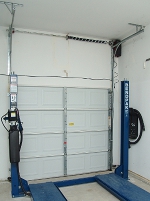
Custom high-lift conversion kits are available for purchase.
To learn more about how these systems work, see our How Vertical-Lift and High-Lift Doors Work page. If you are interested in the work involved when performing a high-lift conversion, check out our High-Lift Garage Door Conversion tutorial.
If you are interested in converting your standard lift garage door to a high-lift door, please find the dimensions specified in the High-Lift Garage Door Conversion tutorial and fill out the form on our Garage Door High Lift & Vertical Lift Inquiry page. After filling out the form, you will see options for the spring cycle life for your conversion kit and the total cost; we will then contact you to complete your order.
Custom roofline lift conversion kits are also available. Most of these doors travel vertically for a foot or two before reaching the curved part of the horizontal track. Rather than rolling back parallel to the garage floor, the door instead continues to roll back and upward, following the pitch of the ceiling. This option is only available for garages with ceilings that pitch up and away from the door. These conversion kits are also available - visit our Garage Door High Lift & Vertical Lift Inquiry page to receive a quote for a custom roofline high-lift kit.
If you have enough space in your garage for your door to open vertically and are instead interested in a custom vertical-lift conversion kit, please contact us so we can determine the parts you need and the cost of your new kit.
Buy Standard Residential Garage Door Torsion Springs
Follow the instructions below to make the proper measurements when looking to buy new torsion springs. Once you have your measurements, you can contact us or use our Find My Spring Database™ and the bottom of this page to order new springs.
Measuring Your Garage Door
What is a balanced garage door?
A balanced garage door will:
1. Stay down when close
2. Stay up when open
3. Not move when in the middle
There are three different methods for determining what torsion springs you need for your garage door. You can 1. Measure your existing springs, 2. Weigh your door with an analog scale, or 3. Determine the manufacturer and model number.
A balanced garage door will:
1. Stay down when close
2. Stay up when open
3. Not move when in the middle
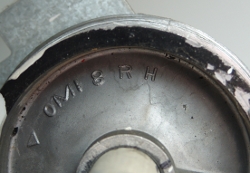
This cable drum says "OMI 8". There is typically a 4 or an 8 on 4-inch diameter cable drums. If the drum says 525 or 575, the diameter is larger.
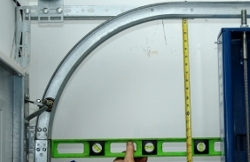
Hold a level at the bottom of the track junction, and measure the distance from the center of the horizontal track to the top of the level.
You will also need your track radius. As pictured, this is the radius of the curved portion of your horizontal track. While this varies from door to door by only a few inches, a larger track radius requires more turns on the spring and therefore slightly increases the lift of a spring while slightly decreasing the cycle life rating.
Your door height will also be a necessary dimension when finding new torsion springs.
Method 1: Measure your existing springs
Torsion springs have five primary characteristics: 1. inside diameter (ID), 2. wire size, 3. length, 4. wind, and 5. type of ends. Determine all of these measurements for each spring that you are replacing.
If you have two springs, we recommend that you replace both springs on your door. If this is the case, be sure to measure both springs. If after measuring you find that your springs are unmatched, you can use our Unmatched Springs Calculator to find a pair of matched torsion springs.
Each of these measurements needs to be taken carefully, so be sure to read our How to Measure Garage Door Torsion Springs page.
If you have a 4" diameter cable drum and you have measured the torsion springs you are replacing, you can enter your spring dimensions in our Find My Spring Database™ to purchase new torsion springs.
Method 2: Weigh your door with an analog scale
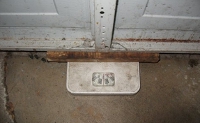
Use an analog scale to weigh your door.
Once you have your garage door weight, door height, cable drum number, and track radius, you can purchase new springs. If you have a 4" diameter cable drum, you can browse our Torsion Spring Prices. Rather than entering specific spring dimensions, you can browse springs for your door height based on the spring's lift. If you have two springs, the lift of each spring will be half of your door weight. You can browse by either 1-3/4" or 2" inside diameter (it does not matter which one you choose); only purchase 2-1/4" ID springs if you have a Raynor door as you may otherwise experience hardware compatibility problems.
Method 3: Determine the manufacturer and model number
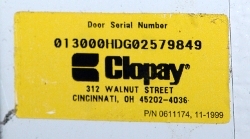
Most garage doors have a label on the bottom section that gives the serial number.
In order to determine the weight, we will also need to know how many struts are on the door. These are silver metal bars that run across the length of the door. They will be either be about 2-1/4" or 3" off the inside surface of the door.
Once we determine the weight of your door, we will need to find springs that will match your door. To do this, you will need to provide your door width and height, your track radius and your cable drum number as mentioned before.
After you have gathered this information (door manufacturer and model number, number of struts, door width and height, cable drum number, and the track radius), contact us so that we can find suitable replacement springs for your door.
Special Orders
If you do not have a 4" diameter cable drum, you will need to contact us so that we can determine the springs you need.
If you have a high-lift or a vertical-lift garage door, our database will not give you accurate spring information. If you can find an exact replacement spring in our database, it will work. Because of the extra turns required on the spring for the lift design, the cycle life will not be accurate. If you are instead finding new springs from your door weight, you will have to contact us so that we can find replacement springs for your system.
If your garage door is higher than 8' tall, please contact us so that we can find replacement springs for you.
If you cannot find your current spring in our Find My Spring Database™, your spring may be overstressed for your door height. Many manufacturers and installing garage door companies are cutting corners and installing garage door springs with cycle lives that fall below the 10,000-cycle industry standard. Try changing your door height to 6' 6". If you then see the spring, consider using one of the suggested cycle life upgrades for the 6' 6" high door for your taller door. If you can't find it there contact us. We will find their torque ratings and recommend suitable higher cycle replacements. We may also ask questions about your garage door to make sure your measurements are correct. We will sell springs rated below the 10,000-cycle minimum, but we will not accept returns on any of these springs.
Purchase Standard Torsion Springs with our Find My Spring Database™
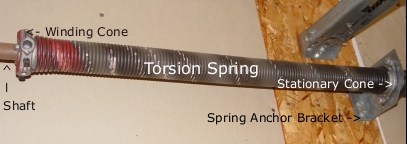
Garage Door Torsion Springs are normally centered above the garage door on a one inch shaft. At one end of the spring is the winding cone that is secured to the shaft with set screws. At the other end of the spring is the stationary cone. This is secured to the spring anchor bracket, which is secured to the header. On two-spring assemblies the stationary cones of both springs are mounted back to back to the spring anchor bracket. The shaft running through the springs transfers tension from the springs to the cable drums at the end of the shaft. These drums pull on the cables, which pull on the bottom of the door to balance the weight of the garage door.
When you cannot use our Find My Spring Database™:
1. Your cable drums are not 4" in diameter.2. You have a high-lift or vertical-lift door.3. You have a commercial door.4. Your door is greater than 8' high.If you cannot use our database, contact us with the information listed above.
Our database below is based on garage doors utilizing 4" diameter cable drums with 12.6" circumferences on the flat portion. The most common 4" cable drums are marked with the following identifying numbers: WD-4, WD-4X, 400-8, 400-9, OMI-8, DNS-4X-8, D400-96, 1000, 1001.
1. Your cable drums are not 4" in diameter.2. You have a high-lift or vertical-lift door.3. You have a commercial door.4. Your door is greater than 8' high.If you cannot use our database, contact us with the information listed above.
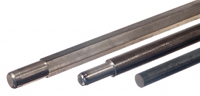
Winding bars are necessary for replacing your springs.
All the residential torsion springs we provide are wound with 1/2" rods, usually 18 inches. You can buy 1/2" X 36" rod at almost any hardware store and cut one in half. If you would like for us to include a pair of winding rods in the order you can follow the links at our Garage Door Tools & Technical Support page.
Customers have also asked us about whether they should replace their cables, end bearing plates and center bearings. Cables normally don't need to be replaced. It would be good, however, to check for frays along the length of each cable and for rust at the bottoms if they are subject to salt corrosion. If needed, you can purchase new cables on our Garage Door Cable and Fittings page. The end bearing plates rarely need to be replaced. The Chinese made some bearings several years ago stamped with the letters "ADH." These, along with some of the old McKee Door end bearings are about the only ones we've seen wear enough to warrant replacing. It is even rarer when a center bearing needs to be replaced. In our experience it's probably only one in 5,000 or more spring replacements where a new bearing would be needed. That's usually only on center support brackets that were not installed plumb or perpendicular to the header. A drop or two of oil is usually all that most center bearings ever require. If needed, you can purchase these parts on our Garage Door Bearings & Bushings page.
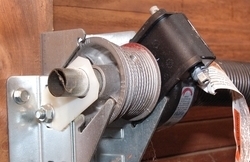
Torsion springs for EZ-Set systems cannot be purchased through our database.
EZ-Set Springs: Do NOT use this database
Clopay and Ideal make EZ-Set springs that wind with a drill. These springs are specially gapped, and they are made differently from the springs in our database program. If you have EZ-Set Springs, you can order the spring or springs you need on our EZ-Set Garage Door Torsion Springs page. However, if you live near the coast, and if you have a wind-rated door, you will need to call or e-mail us to order the correct springs.
Commercial Torsion Springs
Garage door torsion springs on larger sectional and rolling steel doors come with many additional inside diameters. For information and prices visit our Commercial and Industrial Torsion Springs page.
Overhead Door Cones
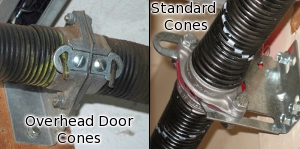
Springs used with Overhead Door cones need to have their ends bent upward to fit in the clips.
When ordering springs for the older style Overhead Door brackets, let us know in the comment section. Notice in the picture that standard cones are wider where the bolts pass through them. The one inch bolts used in the older Overhead Door cones are not long enough to secure the cones to the bracket. We will provide longer bolts and wider flange nuts at no charge to help with your project.
We don't recommend reusing the cones because they are dangerous; the hole sizes for the winding bars are inconsistent.
However, if you do decide to order two-inch inside diameter springs without cones, let us know in the comment section if you have Overhead Door cones so we can bend up the ends of the spring wire to fit in the clips. These clips keep the spring from spinning off the cones. Standard cones screw into the spring and are held in place by friction.
Shipping Times
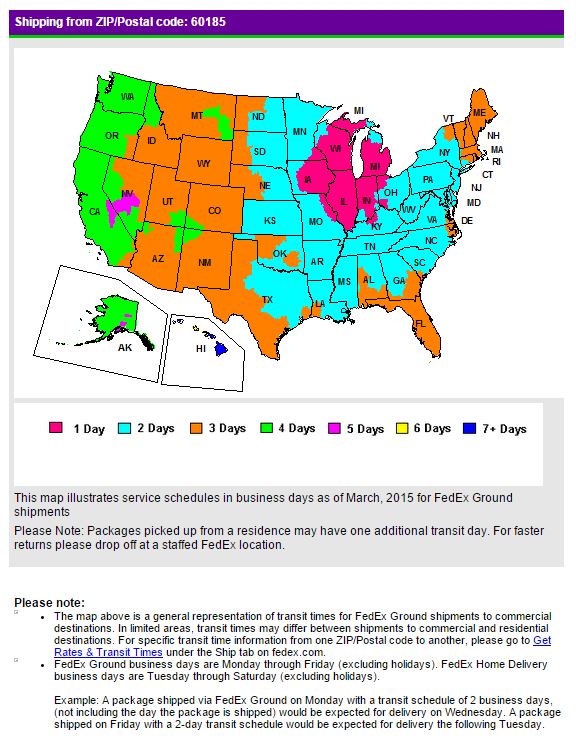
PLEASE NOTE. Shipping times are not guaranteed, even on next day and second day shipments. Normal times do not apply.
At DDM Garage Doors, Inc. we strive to minimize shipping times and shipping costs. Getting the springs to customers for their weekend DIY projects without extra shipping costs is a priority.
Most springs ship same or next business day from our warehouse in West Chicago. We also sometimes ship by Priority Mail. If you have a preference please note that when ordering. We also ship internationally.
In all of Illinois, in most of Iowa, Wisconsin, Michigan and Indiana, and in selected parts of Missouri, Kentucky, Ohio and Minnesota, springs are usually delivered in one day - including Saturday - at no extra cost. In this select midwestern area you can usually order on Friday and get the springs on Saturday. Please contact us if the shipping time is critical.
If you need the springs sooner let us know in the comment box of your order, and we will try to expedite your order. Usually extra shipping charges will apply.
Customer Pickups. Many customers in the greater Chicago area stop by to pick up springs at our warehouse in West Chicago. If you order on line you can select the option for picking up your parts. Just contact us to make arrangements.
Returns
It is our priority here to protect you from the dangers of replacing garage door springs, and it is also our policy not to profit from customers' mistakes. To help you perform the work safely, and to help you order the correct springs, we have invested heavily in our torsion spring replacement tutorial and video, and our torsion spring measurement tutorial and video. Many have acknowledged these as the best ever produced, even in spite of the social media mafia's thumbs down comments on these two videos. We labor extensively to help you get what you need the first time. Our salesmen call about 10% of our customers when their orders don't look right based on over 20,000 springs I've measured and replaced in my 43 years in the garage door industry.
In spite of our best efforts, customers do sometimes order the incorrect springs. Returns on all torsion springs in our database below are accepted for up to 60 days as long as they are in their original condition. They must be returned to our West Chicago warehouse regardless of their original shipping point. The customer pays for the original shipping as well as for shipping to return the product. Please allow five to 10 days for the refund we send by check or by Zelle.
Order Garage Door Springs with Confidence!
Be an informed buyer. Check us out. Enter DDM Garage Doors Reviews in the search box of your browser. Click the BBB link below; you'll see that none of our customers have had to contact the BBB to resolve disputes. Critical customer remarks have never been removed from our guest book. Selling only what you need is a matter of integrity for us. We welcome the opportunity to serve you and to earn your trust.
Same or Next Day Shipping - No Extra Charge!
Place your order by noon central time for same or next day business shipping on most of the 6,000 springs below for residential and light commercial sectional overhead garage doors.

Torsion Spring Specials! - Save 40% on Pre-Cuts!

By providing pre-cut spring lengths, we reduce processing costs and pass the savings on to you in the form of a 40% discount to the 48 contiguous states.
Same or Next Business Day Shipping! Free Winding Bars, Goggles, Written Instructions and Extended Two Year Warranty on the Springs.
With the goggles you also minimize the risk of eye injury, the number one cause of door injury trips to the doctor. Metal debris gets in one's eyes because of the tendency to look up at the door as it opens.
Order precuts by clicking HERE.
If you have springs with 1 3/4 inch or 2 1/4 inch inside diameters, you can usually convert to 2" ID springs and save as much as 25 percent on the standard non-precut springs.
How To Measure Torsion Springs * How to Replace Garage Door Springs (2 Springs) * How to Replace Garage Door Springs (1 Spring) * How To Convert Inside Diameters